Media
Press & Public Coverage
Coverage of research on quantum entanglement in hadronization, detector development for the Electron–Ion Collider, and the pfRICH vessel construction at Stony Brook University / Brookhaven National Laboratory.
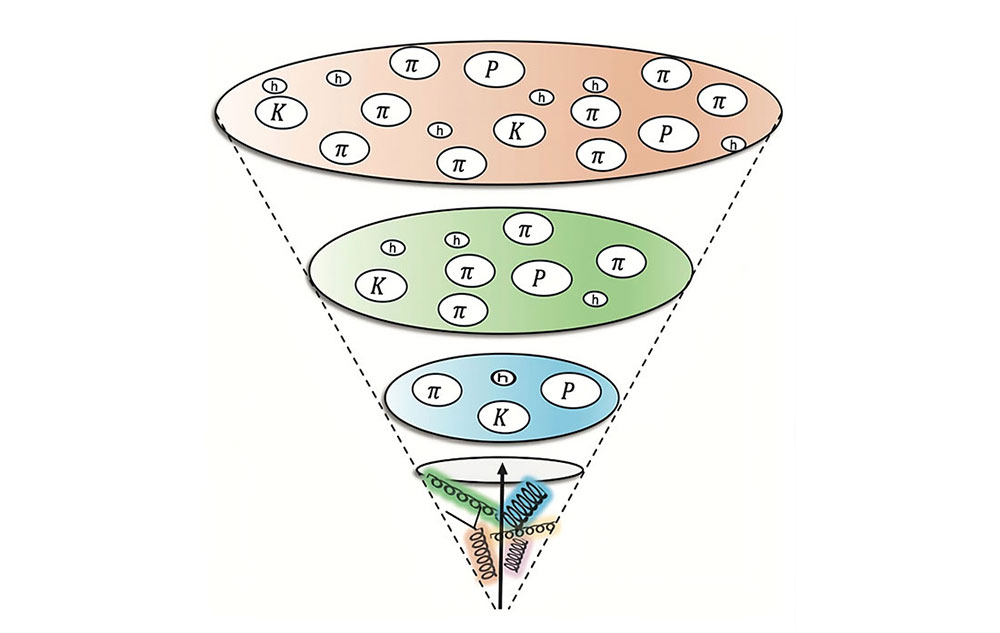
When an energetic quark or gluon is knocked free in a proton-proton collision, it fragments into hadrons (kaons, pions, protons). When the entropy of the hadrons equals the entropy of the fragmentation process, the system is maximally entangled. Credit: Charles Joseph Naïm / Stony Brook University.
01
Press Coverage
Coverage of "Entanglement as a Probe of Hadronization" (Phys. Rev. Lett. 134, 111902), an Editor's Suggestion for Physical Review Letters, and the completion of the pfRICH detector vessel for ePIC.
Brookhaven National Laboratory — Newsroom
Maximal Entanglement Sheds New Light on Particle Creation
The lab's official press release, with direct quotes: "Despite extensive research, the connection
between a jet's initial conditions and its final particle distribution has remained elusive," said
Naïm. "This study, for the first time, establishes a direct connection between the 'entanglement
entropy' at the earliest stage of jet formation and the particles that emerge as a jet evolves."
Funded by CFNS, DOE Office of Science, the Co-design Center for Quantum Advantage, and a BNL LDRD project.
Read the release

Stony Brook Medicine News
Study Sheds New Light on Particle Creation
Stony Brook's syndication of the same result, quoting Naïm on the significance of the finding and
linking through to the full BNL story.
Read the article
Phys.org
A New Approach to Probe Hadronization via Quantum Entanglement
An in-depth interview piece, quoting Naïm as corresponding author: "Our study originated from the
intriguing observation that the internal structure of protons at high energies exhibits maximal
quantum entanglement," and detailing how ATLAS/LHC data were used to validate the theoretical
framework linking fragmentation functions to hadron entropy.
Read the article
CFNS News — Stony Brook University
CFNS Group Completes pfRICH Vessel for the EIC
Announcement of the completed proximity-focusing Ring Imaging Cherenkov (pfRICH) vessel — a
carbon-fiber composite structure with an aramid honeycomb core — the result of a year-long project
led by Charles-Joseph Naïm with graduate students Julian Driebeek, James Shirk, and Brynna Moran,
and undergraduates Emmett Gebb, Saanvi Madishetty, and Mahmodol Mojumder.
Read the announcement
02
Photo Gallery
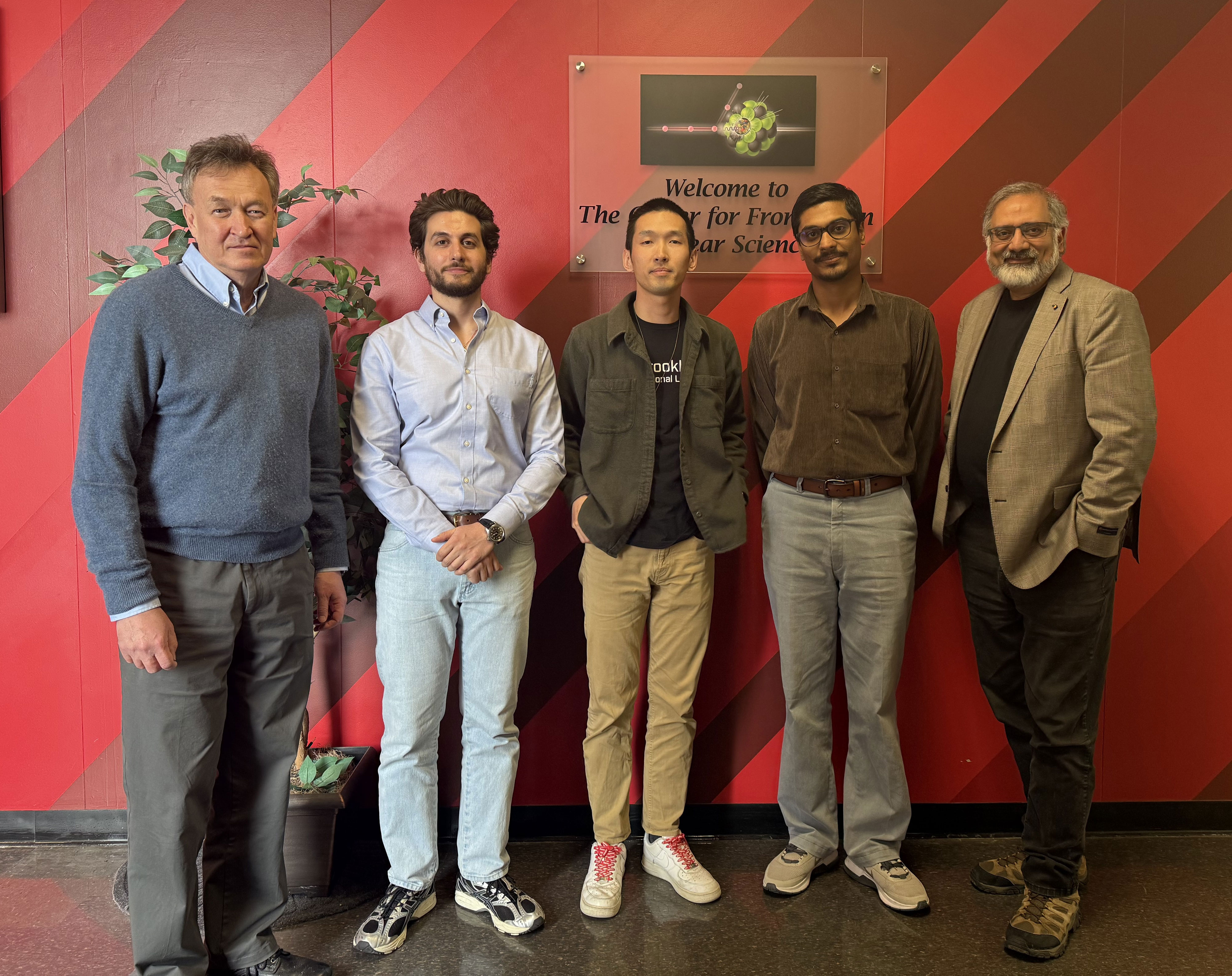
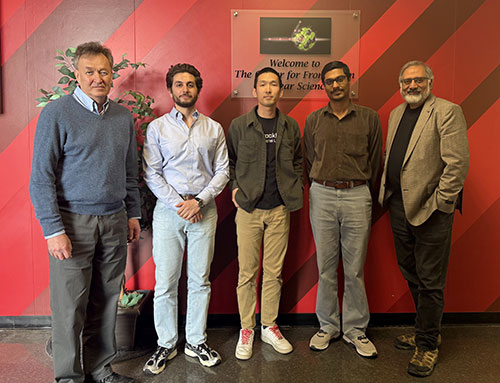
Study co-authors Dmitri Kharzeev, Charles Joseph Naïm, Zhoudunming Tu, Jaydeep Datta, and Abhay Deshpande at CFNS, Stony Brook University. Credit: Rachel Rodriguez / Stony Brook University.
Illustration of parton fragmentation into hadrons, used to explain the maximal-entanglement result. Credit: Charles Joseph Naïm / Stony Brook University.
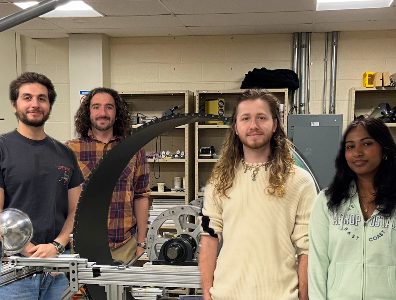
Charles-Joseph Naïm, Julian Driebeek, Emmett Gebb, and Saanvi Madishetty around the completed pfRICH vessel. Credit: CFNS / Stony Brook University.
03
DOE FY 2026 Congressional Budget Justification
The research was highlighted as a program accomplishment in the U.S. Department of Energy's FY 2026 Congressional Budget Justification for the Office of Science, under the Nuclear Physics program.

U.S. Department of Energy — Office of Science
"Quantum Computing to Understand Entanglement of Quark Jets"
A program accomplishment entry in the FY 2026 Congressional Justification (Volume 5, Science), citing
the Stony Brook / BNL entanglement-hadronization work as an example of DOE-funded nuclear physics
research: physicists used quantum computing methods to investigate the entanglement of quark jets,
finding the jets are indeed entangled and that this entanglement is significantly affected by quark
confinement — with implications for both physics experiments and near-term quantum-computing use.
Read the full justification (PDF, p.222)